How a tracker gets to three millimetres.
What is solved, what is not, and the order we are doing it in. Every figure on this page is a target we are building to, and the last section lists what still stands in the way.
Nine sections, one microwatt.
The nine sections
01 / 09One number
One microwatt
One millionth of a watt. That is the average power a Speck may draw. A cell that fits inside three millimetres holds about two milliwatt hours, and at one microwatt that lasts three months.
Fig. 01. A Speck over the wafer its chip is cut from. Generated film.
The whole design is one number.
02 / 09Dome to base
Six layers, 1.2 mm
Nothing in a Speck does one job. The dome is the lens, the aerial and the speaker. The base is the seal, the lock and the mount.
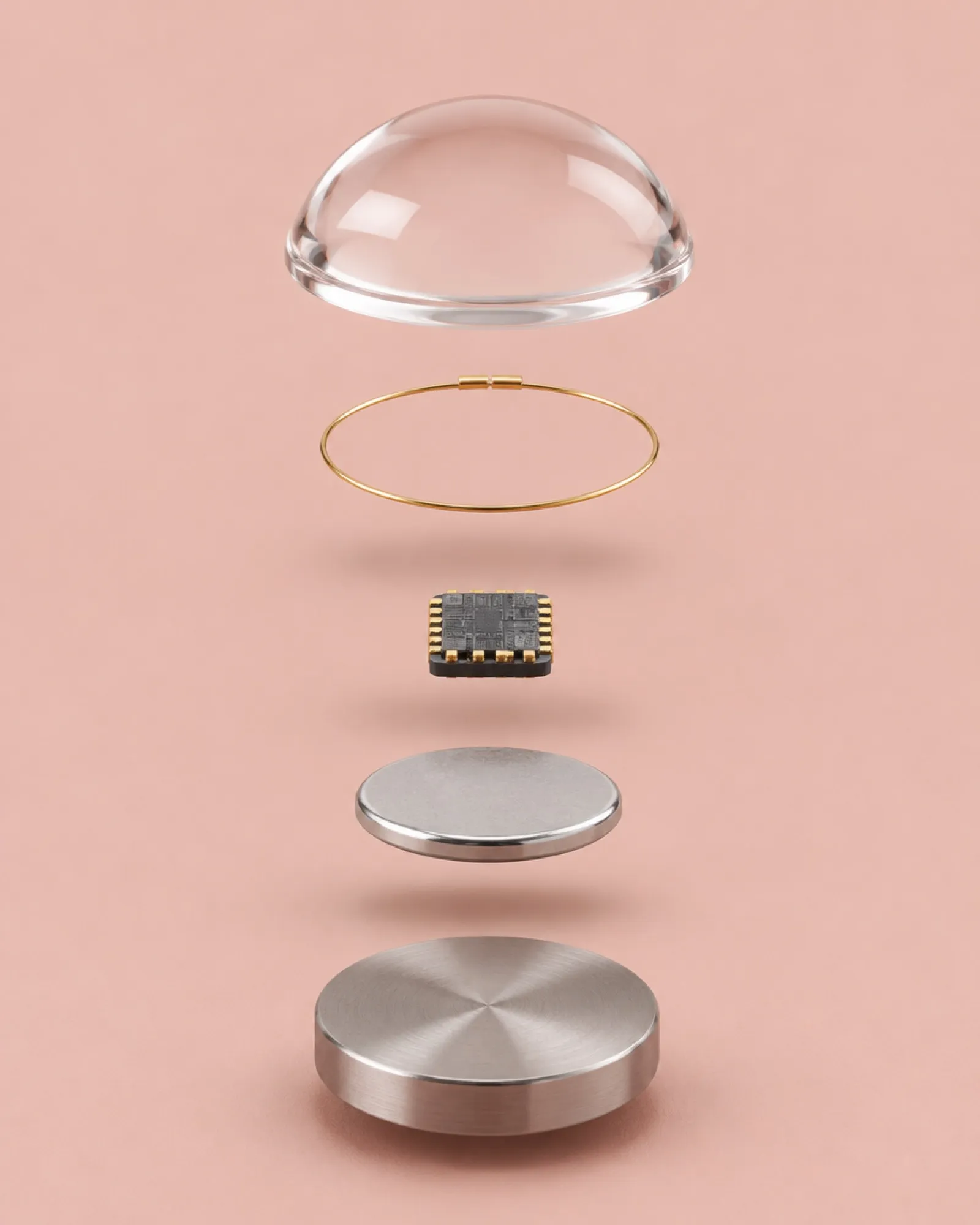
Fig. 02. The stack, pulled apart.
| Layer | Size | Job |
|---|---|---|
| Dome, sapphire | 3.0 mm wide | Lens, aerial carrier and sounder |
| Aerial, printed gold | 2.6 mm loop | The 2.4 GHz radiator, on the inside of the dome |
| Light cell | 2.2 mm square | Tops up the cell whenever there is light |
| Chip | 2.0 by 1.1 mm | Bluetooth radio, motion sensing, encryption |
| Cell | 2.4 mm wide, 0.5 mm high | The energy store, and the part you replace |
| Base, steel | 3.2 mm wide | Seal, quarter-turn lock and mount face |
03 / 09The spend
Where the microwatt goes
A Speck that is sitting still has nothing new to say, so it says it less often. Movement wakes it up.
| Spend | How | Budget |
|---|---|---|
| Announcing itself | One short Bluetooth advert every 2 seconds when moving, every 10 when still | 0.6 µW |
| Sleeping | Everything off but a clock | 0.1 µW |
| Feeling movement | A motion switch, not a full accelerometer | 0.1 µW |
| Ringing and alerts | A few chirps a week, averaged out | 0.1 µW |
| Rotating its identity | A new encrypted name every 15 minutes | 0.1 µW |
| Total | Averaged over a normal week | 1.0 µW |
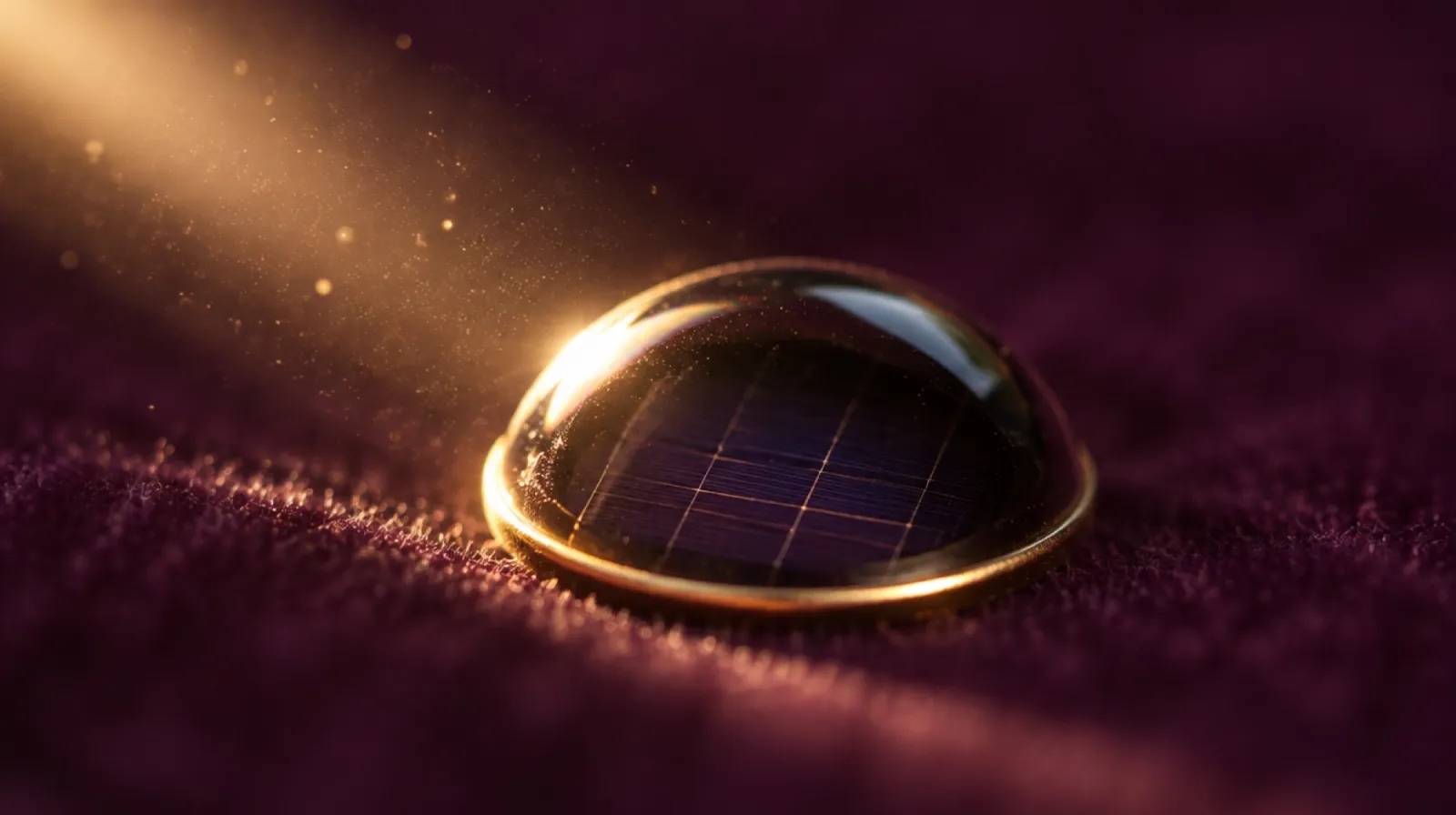
Light pays some of it back
Under the dome sits a light cell seven square millimetres in area. In a lit room it returns up to a microwatt. In sunlight, hundreds. On a pair of sunglasses the cell may never run down.
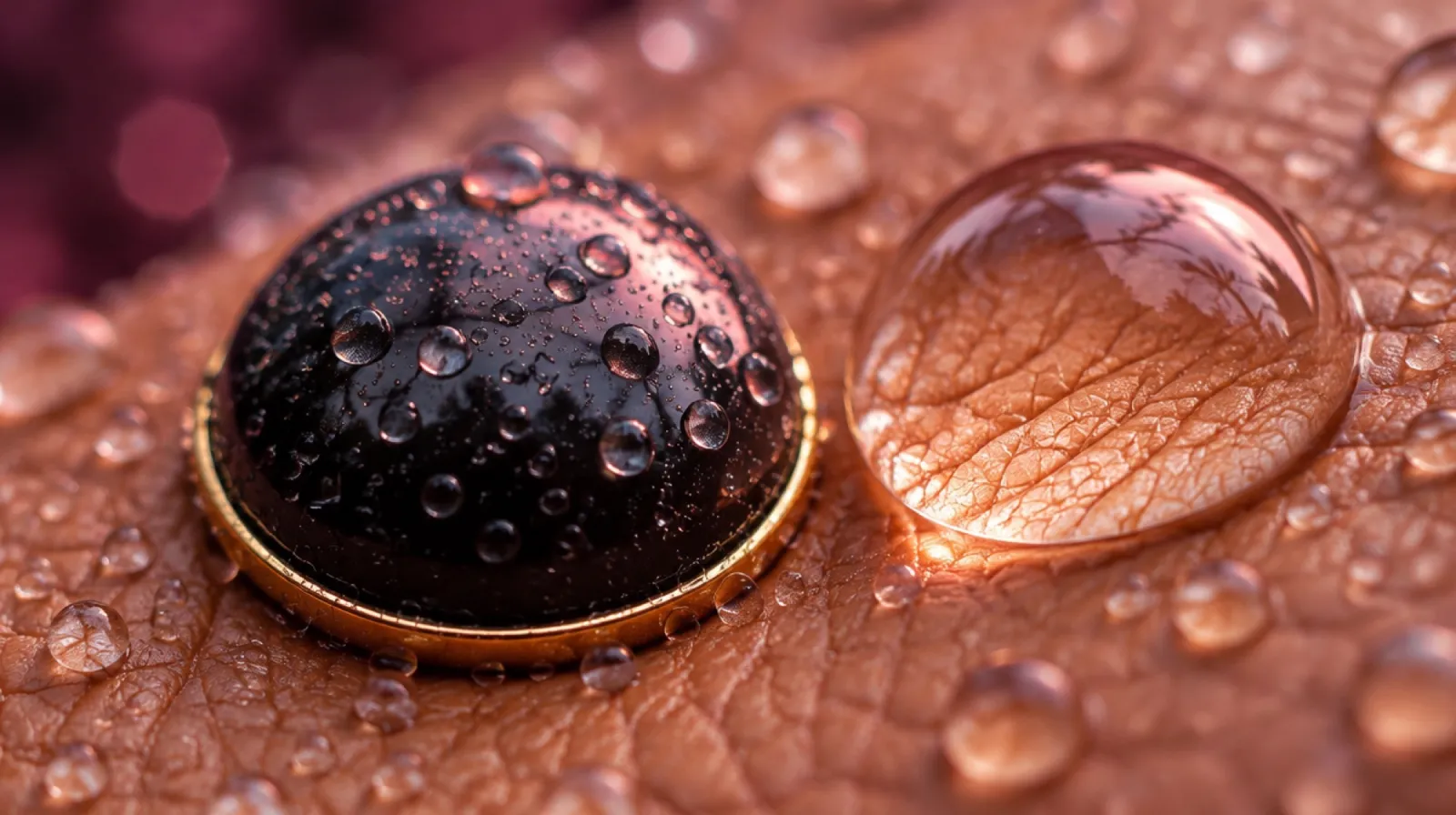
Water stays out
The base closes on a ring seal with a quarter turn. The target is IP67: rain, sweat, a hand wash, half an hour under a metre of water.
04 / 09The roadmap
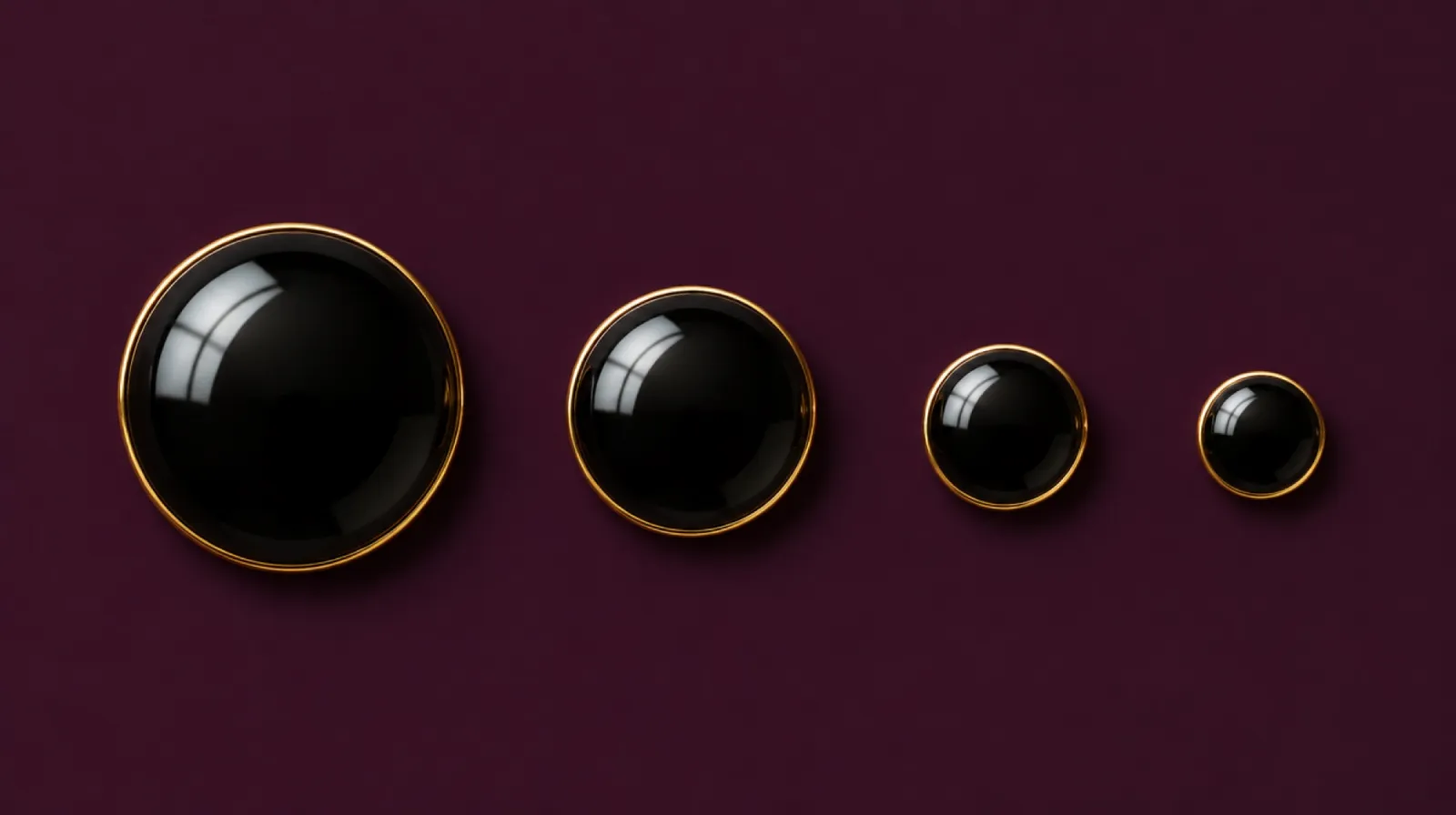
From eight to three
A tracker can be built at 8.4 mm today from parts in a catalogue. Each step after that removes one thing that is only there because nobody has needed it smaller.
Fig. 04. Eight, six, four, three.
| Step | Width | What changes | Cell life |
|---|---|---|---|
| Catalogue parts | 8.4 mm | A watch cell, a standard chip, an aerial on the board | About 3 months |
| First shrink | 6 mm | The chip loses its package. The aerial moves into the dome | About 3 months |
| Second shrink | 4 mm | A stacked micro cell. Light top-up. Motion-aware adverts | 3 months, with light |
| Speck | 3 mm | Chip, cell and light cell built as one part | 3 to 6 months |
05 / 09The mount
Holding on
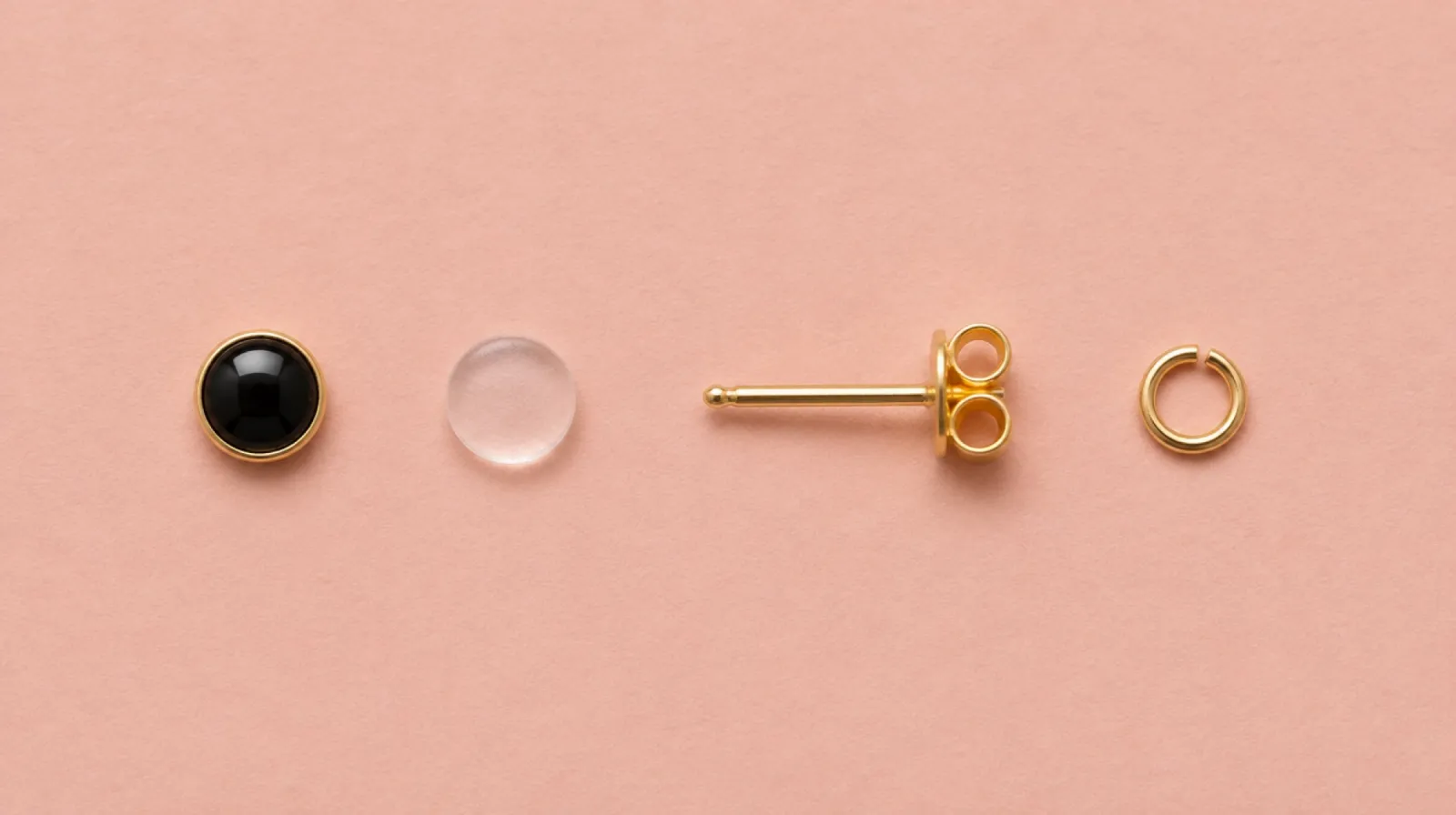
A tracker that falls off is a lost thing with a battery. So the mount is designed first, working backwards from what will try to remove it.
Fig. 05. A Speck, its pad, the locking pin and the loop. All four come in the box.
| Load | Force on a 0.05 g Speck | Margin on a 30 N cured bond |
|---|---|---|
| Its own weight | 0.0005 N | 60,000 times |
| A 1,000 g shock, a drop onto tile | 0.5 N | 60 times |
| Rubbing in a pocket or a bag | Up to 2 N | 15 times |
| A fingernail at the rim | Up to 10 N | 3 times, and a dome with a 1.2 mm rise gives the nail almost nothing to push on |
A bond that sets by itself
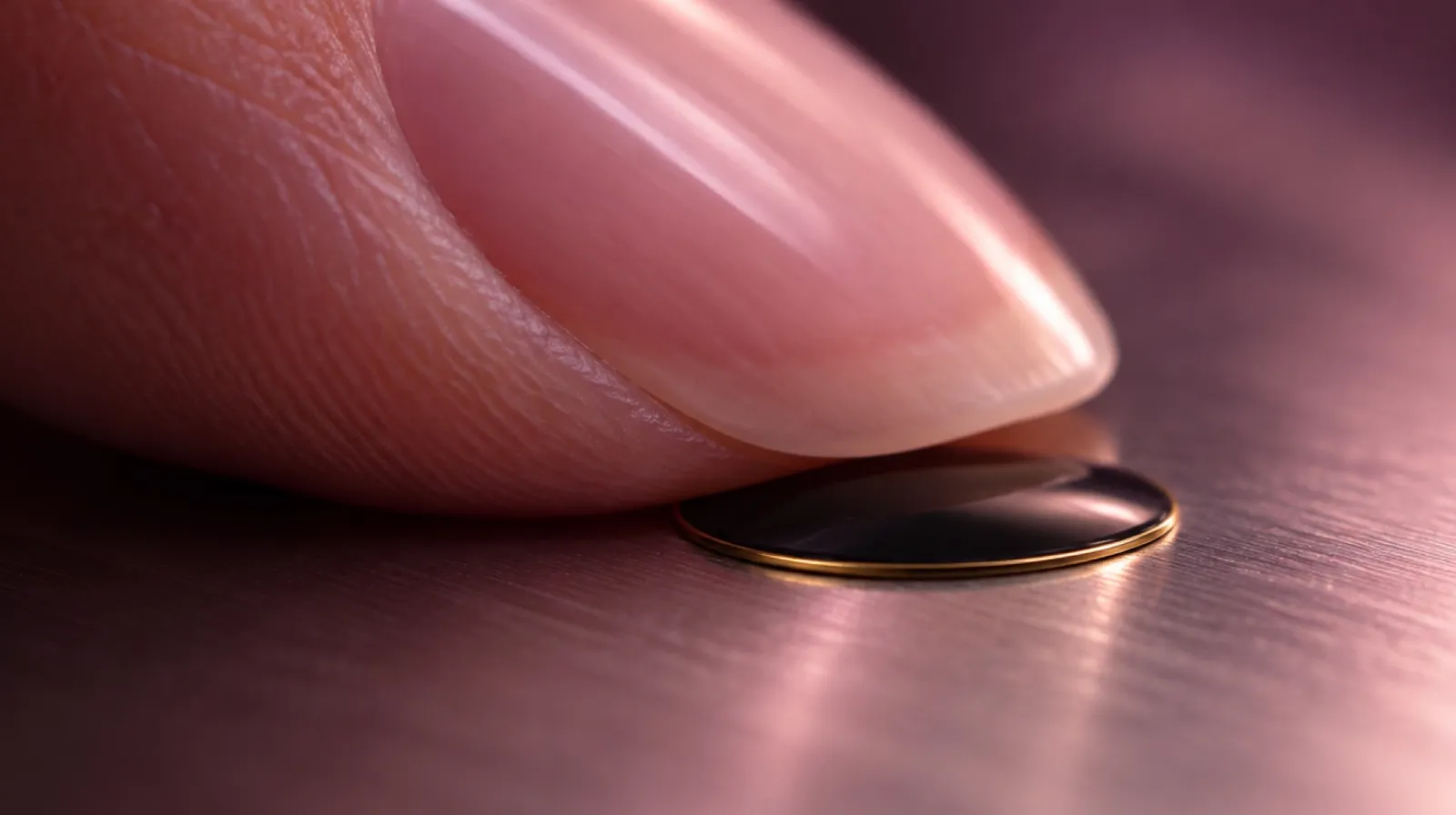
The pad is fitted at the factory, so the customer peels and presses and does nothing else. It is a curing pressure-sensitive adhesive: it grips at once with about 3 N, then hardens over a day using the moisture in the air, with no light, primer or mixing. The target once cured is 30 N.
A pin that locks
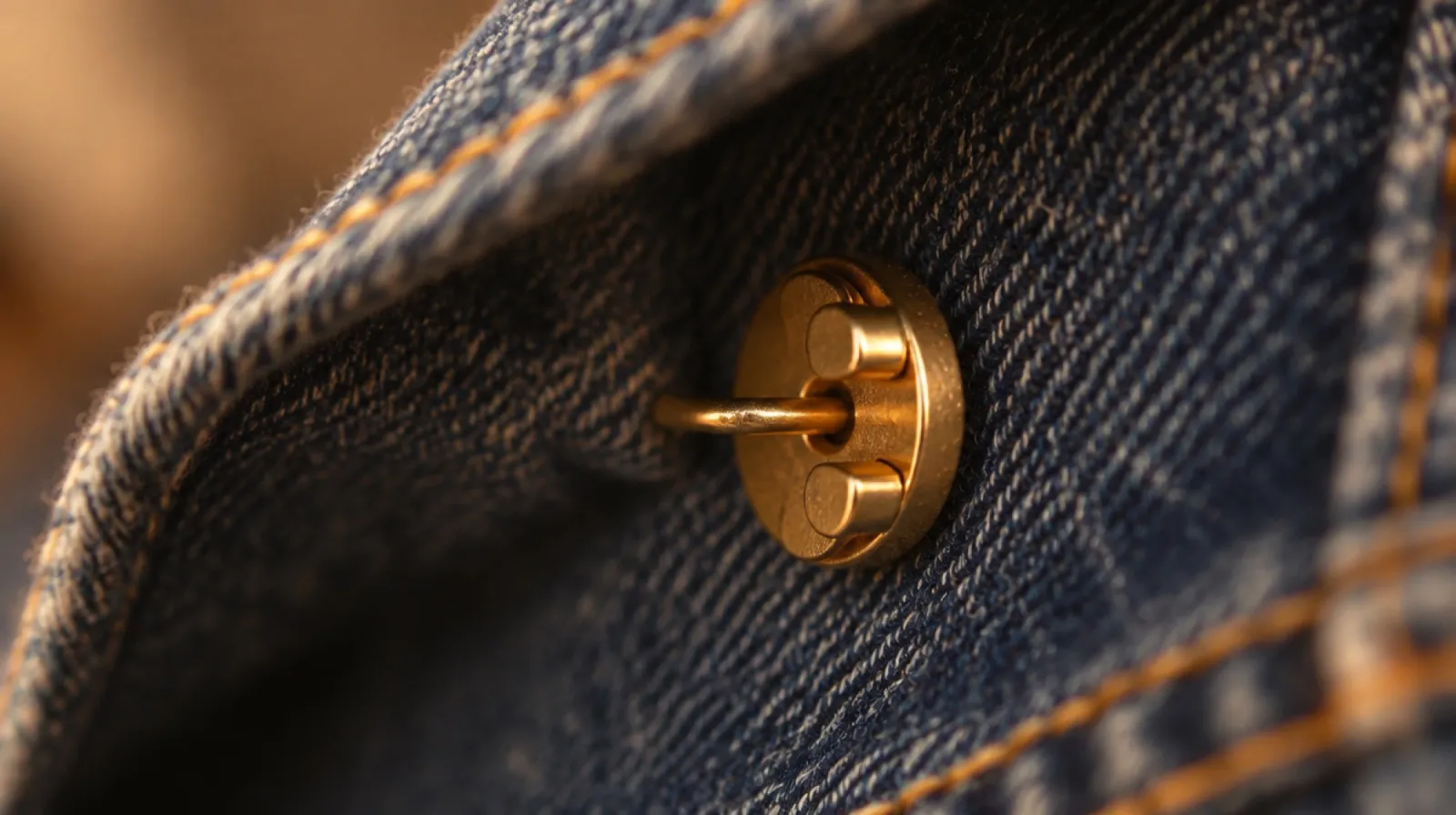
Cloth cannot be glued and stay washable, so it is pinned. A 0.7 mm steel post passes between the threads without cutting them and seats in a spring-collar back. The collar only opens when both tabs are squeezed, which a snagged thread or a small hand cannot do.
| Mount | Target | Comes off by |
|---|---|---|
| Press | 30 N sideways on steel and glass, 15 N on acetate, hard plastic and leather, from -10 to 70 °C | A firm twist with the key, then peel the pad |
| Pin | 20 N straight pull | Squeezing both tabs of the back |
| Loop | A 0.5 mm ring through an eyelet in the base, closed by a screw collar. Stronger than a fine chain | Unscrewing the collar |
| Surface | Mount | Preparation |
|---|---|---|
| Steel, brass, gold, silver, glass, ceramic | Press | A clean, dry surface |
| Acetate, hard plastics, lacquered wood | Press | A clean, dry surface |
| Leather, rubber soles, cork | Press, with the thicker pad that flows into the grain | Press for longer |
| Polypropylene, silicone, waxed or oiled surfaces | Loop or pin. Glue does not hold on these, and we do not pretend it does | None |
| Woven and knitted cloth | Pin | None |
| Chains, laces, zips, wire frames | Loop | None |
The base is the part that is bonded. The dome twists out of it for a new cell, so changing the cell never disturbs the mount.
06 / 09The radio
A very small aerial
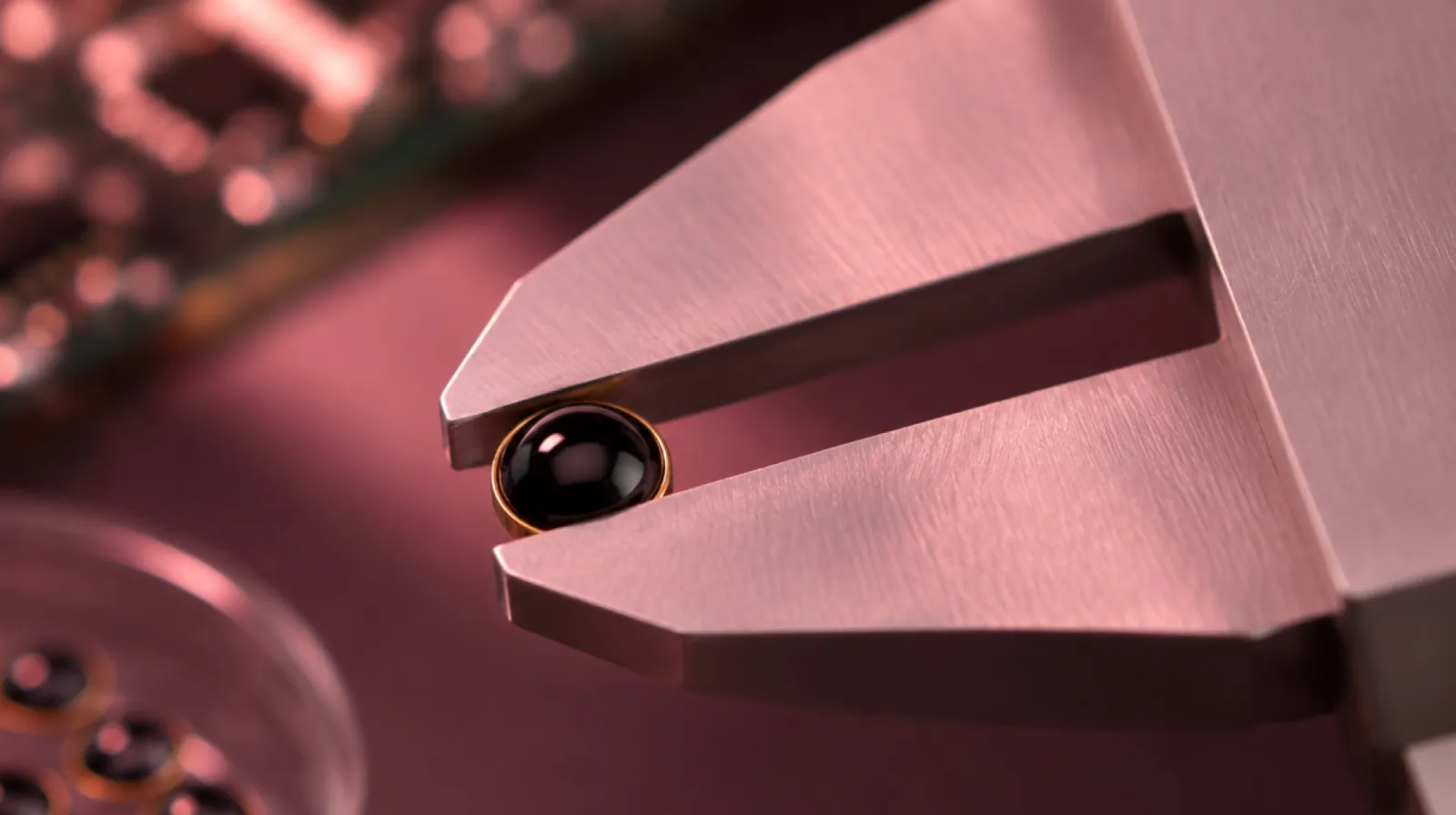
Bluetooth waves are 125 mm long. A 3 mm aerial is a whisper, and we design for a whisper.
Fig. 06. Three millimetres, measured.
| Band | Bluetooth Low Energy, 2.4 GHz |
|---|---|
| Aerial | A gold loop printed inside the dome, clear of the cell and the base |
| Range | Up to 30 m in the open, a room or two indoors |
| Why that is enough | It only has to reach the nearest phone, and there are billions of phones |
| Networks | Apple Find My and Google Find Hub |
| Sound | The dome itself flexes as a piezo sounder, so there is no speaker hole |
 Lunchbox · 900 m
07 / 09The thinking
Where the thinking happens
A microwatt cannot run a neural network. A phone can. So the Speck senses, and the phone thinks.
Plate 04 of the catalogue. The street the app learns.Dive into this painting
| Where | What it does | When |
|---|---|---|
| On the Speck | Feels movement and decides when it is worth speaking | The first Speck |
| On your phone | Learns where each thing lives and when you carry it, and warns you when the pattern breaks | The first app |
| On your phone | Answers plain questions, and names a new Speck from a photo of the object | The first app |
| On the Speck, later | A nanowatt inference chip that can tell a pocket from a table from a fall | On the roadmap |
08 / 09The rules
Rules it must pass
None of these is optional, and each one shapes the hardware.
| Rule | What it asks | What it changes |
|---|---|---|
| Apple Find My programme | Certified hardware, rotating keys, a way to make sound | The chip choice and the piezo dome |
| Google Find Hub programme | Certified hardware on the Android network | A second firmware personality |
| Unwanted tracker standard | A tracker travelling with a stranger must reveal itself | Sound, and identification over Bluetooth |
| Radio approval | FCC, CE and UKCA testing | Aerial tuning on real objects |
| Button cell safety | A cell a child cannot get at | The quarter-turn base needs a tool or two movements |
| Small parts | Not suitable under three years | Locking pin backs, clear labelling |
| Water and dust | IP67 | The ring seal in the base |
09 / 09The honest list
Not solved yet
Six things stand between this page and a Speck in your hand. We would rather list them than hide them.
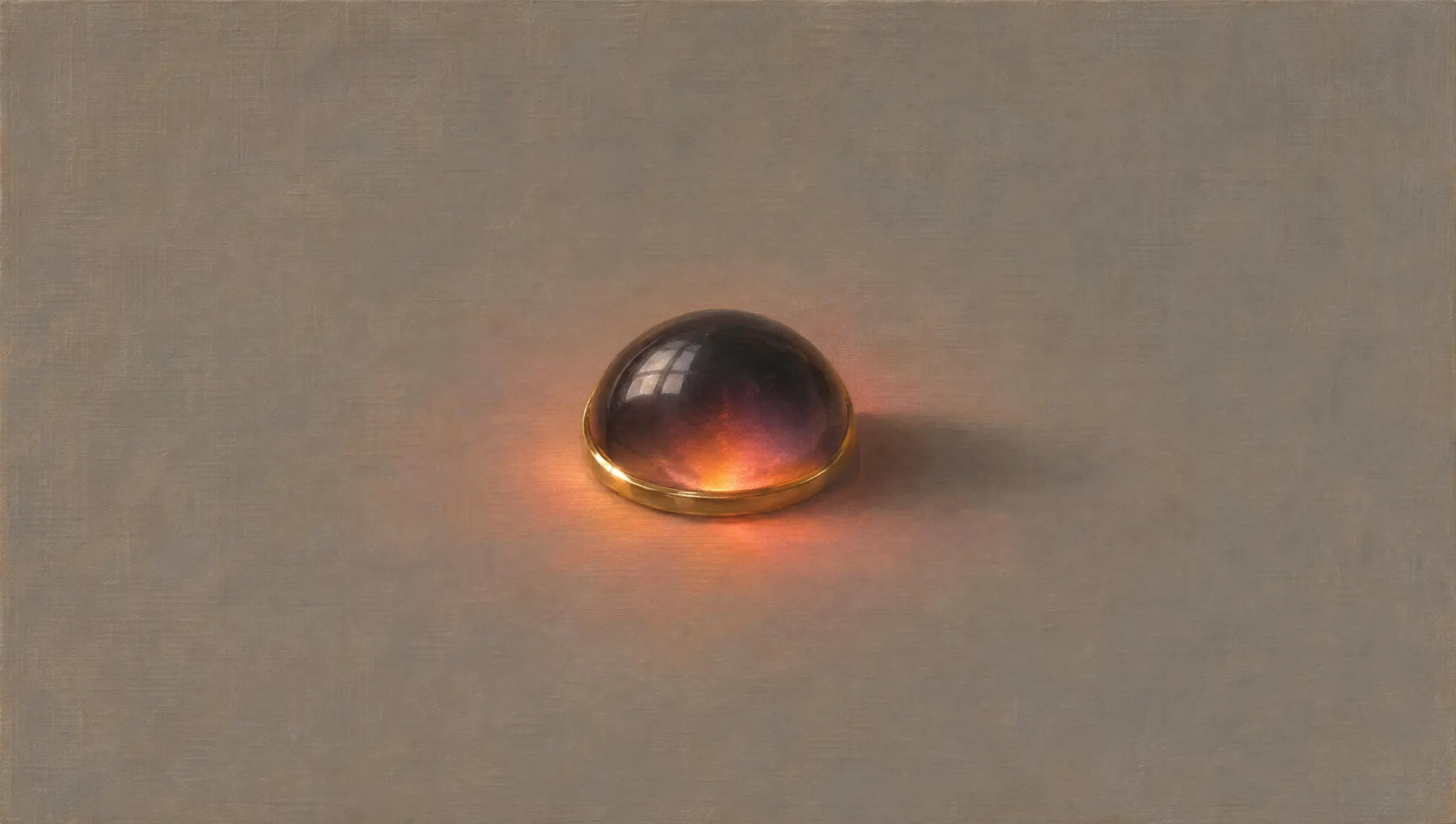
Plate 14 of the catalogue. The only painting of the thing itself.Dive into this painting
The cell
Two milliwatt hours in a 2.4 mm cell is at the edge of what thin cells store today. This is the largest piece of work, and it is why the roadmap goes through 6 and 4 mm first.
The cost of saying hello
The best chips spend about 15 millionths of a joule on each advert. Our budget needs 5. The finding networks also expect an advert every 2 seconds, which on its own costs more than the whole budget, so slower adverts when still have to be agreed with them.
Loud enough
The unwanted tracker standard requires a sound a person can find. A 3 mm dome is a very small sounder. We do not yet know that it is loud enough.
Metal
An aerial pressed against a steel watch or a brass key detunes. The base is designed as a shield between the two, and it needs testing on every surface we name.
Years, not months
A cured bond has to survive sunscreen, sweat, a dashboard in August and ten thousand flexes of a leather strap. The holding figures on this page are targets until our own pull tests, on every surface we name, say the same.
Small hands
A cell door that an adult can open and a toddler cannot is hard at any size. At 3 mm it is a watchmaker's problem.
Three millimetres. Everything else follows.
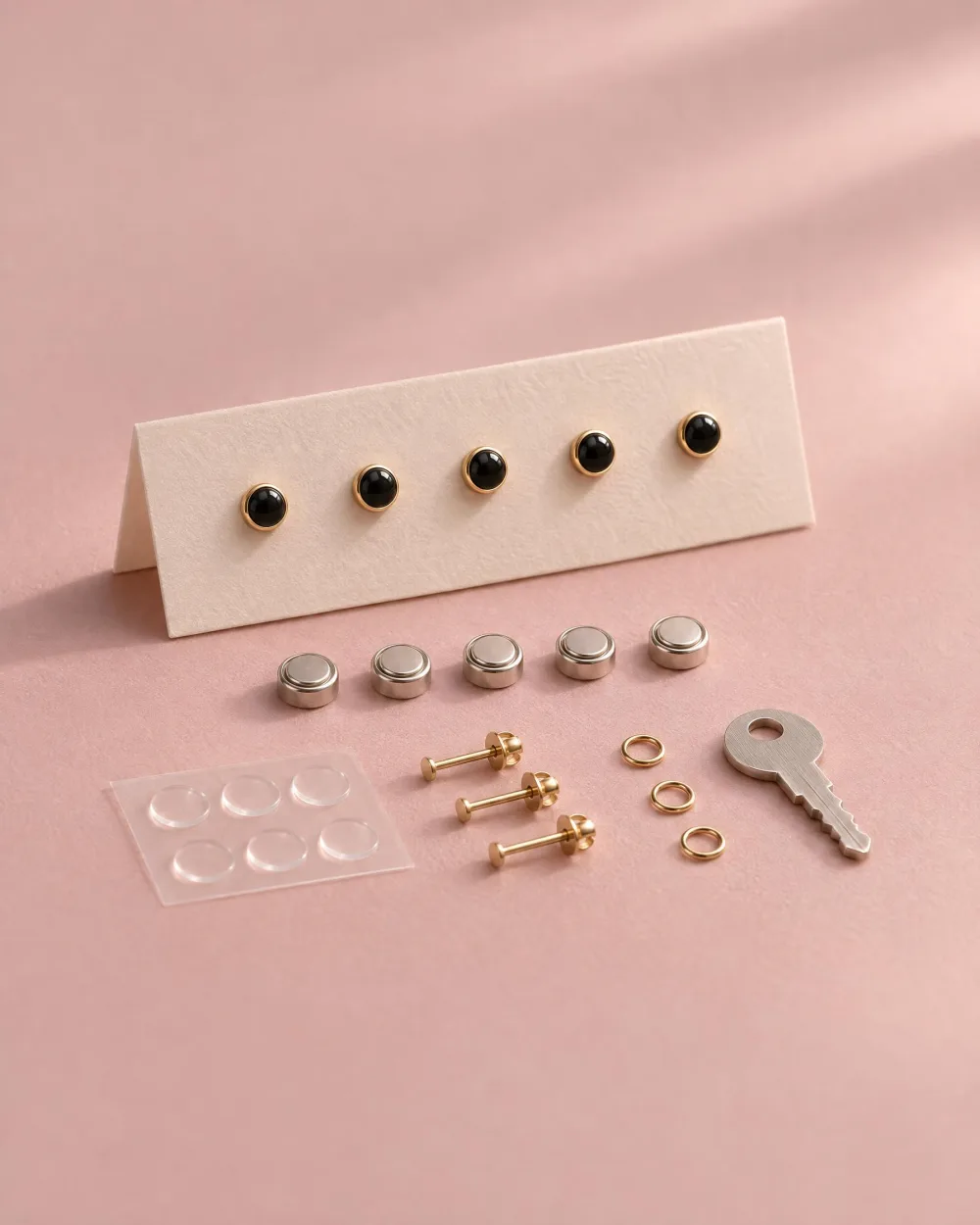
A set of five
- Five Specks in your finish
- Five spare cells
- Pads, pins and loops
- The app, with no subscription
- Pay nothing until it ships
- Cancel whenever you like
Speck is in development. Figures on this page are engineering estimates and targets, to be proven on the bench. Photographs and film are generated visualisations.
Back into the diveThe catalogueFair questionsBack to the top